In today's rapidly advancing motor technology, "quietness," "efficiency," and "reliability" have evolved from nice-to-have features to core competitive differentiators. Whether it's electric vehicles' "smooth acceleration," industrial robots' "precision collaboration," or drones' "long-endurance flights," the performance boundaries of motors are being continuously pushed – and all of this hinges on a critical component: motor lamination bonding technology.
A dissection of conventional motors reveals their laminations are typically secured through welding, riveting, or interlocking structures. Behind this seemingly robust approach lie three critical challenges:
These compromises represent technical limitations rather than optimal solutions. As the industry advances toward "high power density, low NVH, and long service life," we need a disruptive technology – YouYou's Motor Lamination Bonding Technology – to break these barriers.
Unlike traditional methods, YouYou combines high-performance structural adhesives with precision automation to transform laminations from "mechanically assembled" units into "monolithic wholes." Five core advantages redefine motor performance benchmarks:
90% of motor noise originates from lamination vibrations. YouYou's adhesive layer acts as a "mini shock absorber," filling gaps between laminations to form continuous damping structures that dissipate vibrational energy as heat – not transmitted noise. Field tests show NVH reductions of 15-20 dB, equivalent to transitioning from "subway noise" to "library quietness."
High-speed motors (e.g., EV drive motors) operating above 20,000 RPM demand extreme precision. YouYou's technology creates a unified structure with 30%+ rigidity improvement and 50% dimensional stability enhancement, maintaining geometric accuracy even under extreme temperatures (-40°C to 150°C) and heavy loads.
Traditional methods require 20-30% space for mechanical fasteners, while YouYou's adhesive bonding eliminates this overhead. Full-surface bonding enables denser stacking of high-permeability electrical steel, achieving 15-25% power density gains. This translates to:
Motor efficiency declines with temperature – traditional lamination gaps act as thermal barriers. YouYou innovates by embedding high-thermal-conductivity fillers (e.g., boron nitride, alumina) into adhesives, achieving 5-8× thermal conductivity improvements. Heat rapidly transfers through adhesive layers to cooling systems, resulting in:
Accelerated aging tests (1,000 hours at 85°C/85% RH) confirm YouYou's industrial-grade adhesives (e.g., epoxy, modified acrylates) retain 90%+ initial strength while resisting oils, chemicals, and mechanical stress. This "maintenance-free" characteristic drastically reduces lifecycle costs for critical applications like industrial machinery and UAVs.
YouYou's leadership stems not just from technical superiority, but from a customer-centric collaboration model:
As EVs push for "3-second 0-60 mph acceleration" and silent operation, industrial robots demand "millimeter-level precision" and 24/7 reliability, and drones seek extended range with heavier payloads – traditional lamination technology has reached its limits. YouYou's adhesive bonding technology provides the critical breakthrough needed for next-generation motor performance.
As an stator and rotor lamination bonding stack manufacturer in China, we strictly inspect the raw materials used to make the laminations.
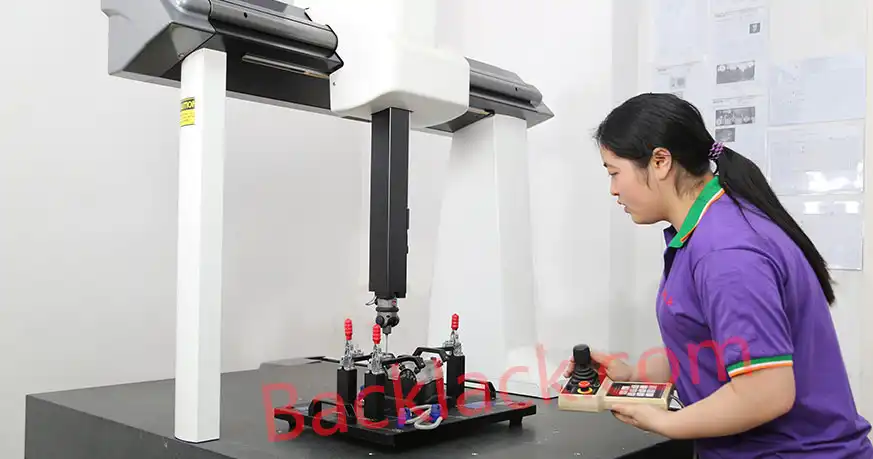
Technicians use measuring tools such as calipers, micrometers, and meters to verify the dimensions of the laminated stack.
Visual inspections are performed to detect any surface defects, scratches, dents, or other imperfections that may affect the performance or appearance of the laminated stack.
Because disc motor lamination stacks are usually made of magnetic materials such as steel, it is critical to test magnetic properties such as permeability, coercivity, and saturation magnetization.
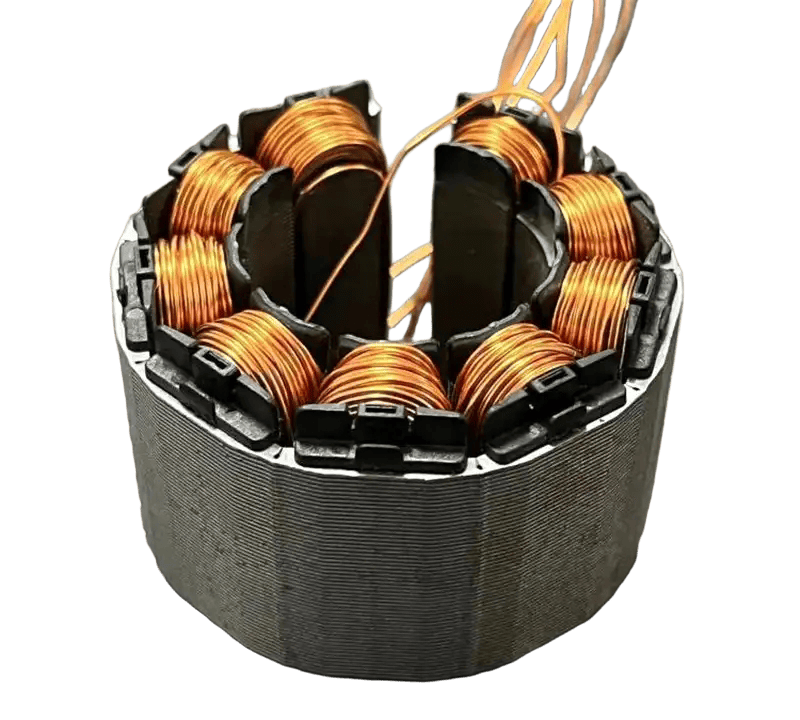
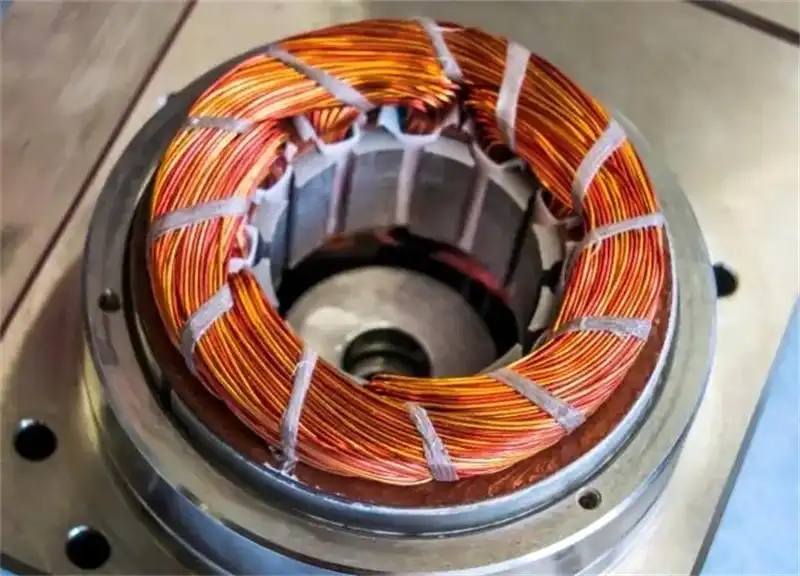
The stator winding is a fundamental component of the electric motor and plays a key role in the conversion of electrical energy into mechanical energy. Essentially, it consists of coils that, when energized, create a rotating magnetic field that drives the motor. The precision and quality of the stator winding directly affects the efficiency, torque, and overall performance of the motor.
We offer a comprehensive range of stator winding services to meet a wide range of motor types and applications. Whether you are looking for a solution for a small project or a large industrial motor, our expertise guarantees optimal performance and lifespan.
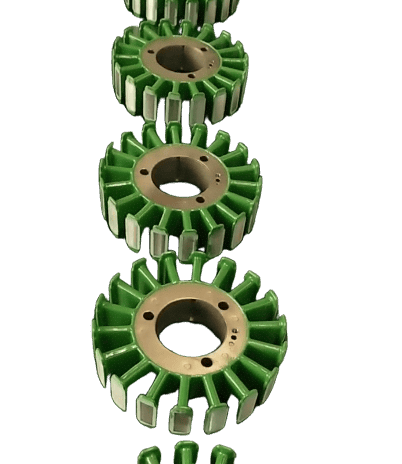
Epoxy powder coating technology involves applying a dry powder which then cures under heat to form a solid protective layer. It ensures that the motor core has greater resistance to corrosion, wear and environmental factors. In addition to protection, epoxy powder coating also improves the thermal efficiency of the motor, ensuring optimal heat dissipation during operation.
We have mastered this technology to provide top-notch epoxy powder coating services for motor cores. Our state-of-the-art equipment, combined with the expertise of our team, ensures a perfect application, improving the life and performance of the motor.
Injection molding insulation for motor stators is a specialized process used to create an insulation layer to protect the stator's windings.
This technology involves injecting a thermosetting resin or thermoplastic material into a mold cavity, which is then cured or cooled to form a solid insulation layer.
The injection molding process allows for precise and uniform control of the thickness of the insulation layer, guaranteeing optimal electrical insulation performance. The insulation layer prevents electrical short circuits, reduces energy losses, and improves the overall performance and reliability of the motor stator.
In motor applications in harsh environments, the laminations of the stator core are susceptible to rust. To combat this problem, electrophoretic deposition coating is essential. This process applies a protective layer with a thickness of 0.01mm to 0.025mm to the laminate.
Leverage our expertise in stator corrosion protection to add the best rust protection to your design.
The thickness of motor core lamination steel grades includes 0.05/0.10/0.15/0.20/0.25/0.35/0.5MM and so on. From large steel mills in Japan and China. There are ordinary silicon steel and 0.065 high silicon silicon steel. There are low iron loss and high magnetic permeability silicon steel. The stock grades are rich and everything is available..
In addition to stamping and laser cutting, wire etching, roll forming, powder metallurgy and other processes can also be used. The secondary processes of motor laminations include glue lamination, electrophoresis, insulation coating, winding, annealing, etc.
You can send us your information, such as design drawings, material grades, etc., by email. We can make orders for our motor cores no matter how big or small, even if it is 1 piece.
Our motor laminate lead times vary based on a number of factors, including order size and complexity. Typically, our laminate prototype lead times are 7-20 days. Volume production times for rotor and stator core stacks are 6 to 8 weeks or longer.
Yes, we offer OEM and ODM services. We have extensive experience in understanding motor core development.
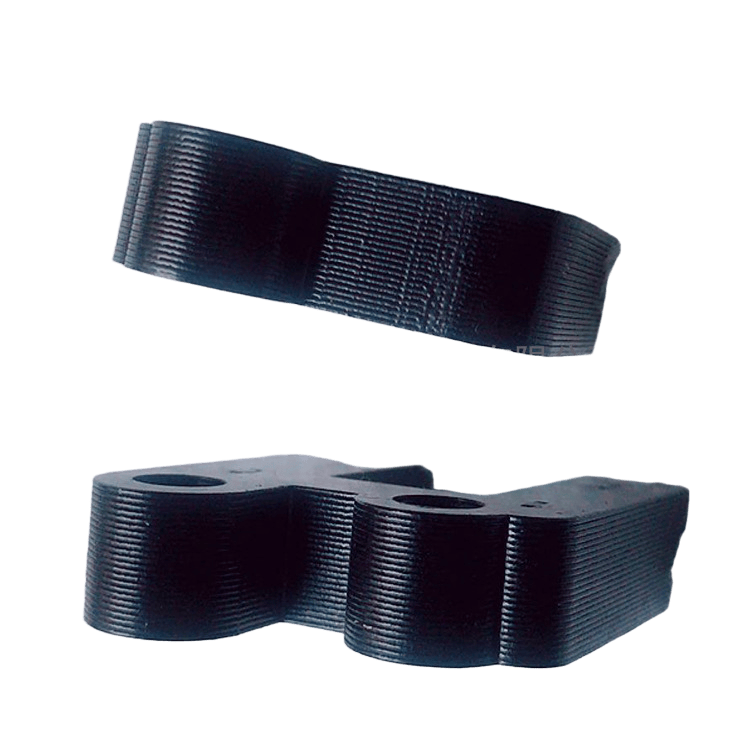
The concept of rotor stator bonding means using a roll coat process that applies an insulating adhesive bonding agent to the motor lamination sheets after punching or laser cutting. The laminations are then put into a stacking fixture under pressure and heated a second time to complete the cure cycle. Bonding eliminates the need for a rivet joints or welding of the magnetic cores, which in turn reduces interlaminar loss. The bonded cores show optimal thermal conductivity, no hum noise, and do not breathe at temperature changes.
Absolutely. The glue bonding technology we use is designed to withstand high temperatures. The adhesives we use are heat resistant and maintain bond integrity even in extreme temperature conditions, which makes them ideal for high-performance motor applications.
Glue dot bonding involves applying small dots of glue to the laminates, which are then bonded together under pressure and heat. This method provides a precise and uniform bond, ensuring optimal motor performance.
Self-bonding refers to the integration of the bonding material into the laminate itself, allowing the bonding to occur naturally during the manufacturing process without the need for additional adhesives. This allows for a seamless and long-lasting bond.
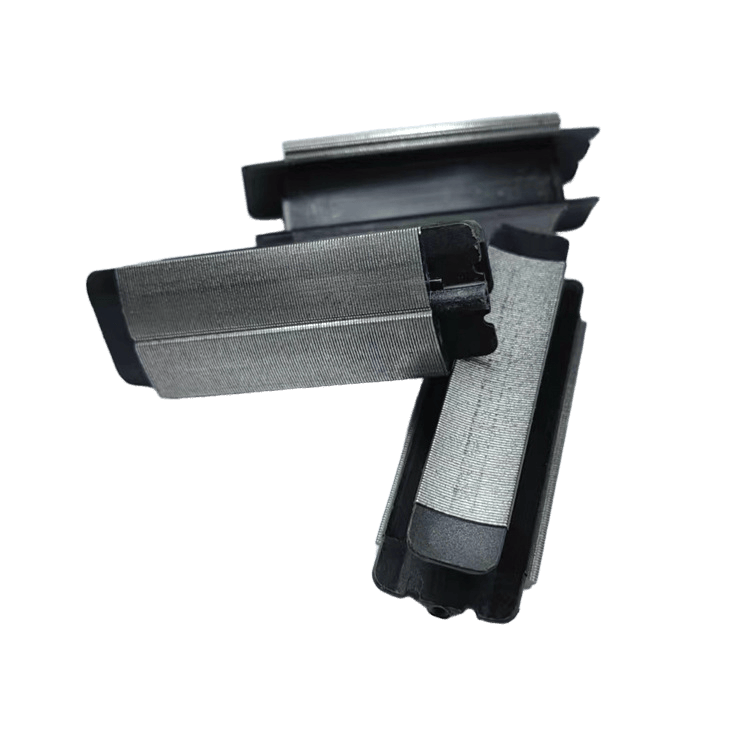
Yes, bonded laminations can be used for segmented stators, with precise bonding between the segments to create a unified stator assembly. We have mature experience in this area. Welcome to contact our customer servic.
Looking for a reliable stator and rotor lamination bonding stack Manufacturer from China? Look no further! Contact us today for cutting-edge solutions and quality stator laminations that meet your specifications.
Contact our technical team now to obtain the self-adhesive silicon steel lamination proofing solution and start your journey of high-efficiency motor innovation!
Get Started NowRecommended For You